Three months into our Erasmus+ project AI Act(ing) in Adult Education, we are already seeing how quickly ideas turn into real collaboration, and how relevant this topic has become for adult educators across Europe. As project coordinators, we kicked things off with a clear ambition: to help adult educators navigate artificial intelligence not just as a tool, but as a responsibility. Now, after the first phase of intensive work, that ambition is beginning to take concrete shape.
A strong start: Our Kick-Off-Meeting
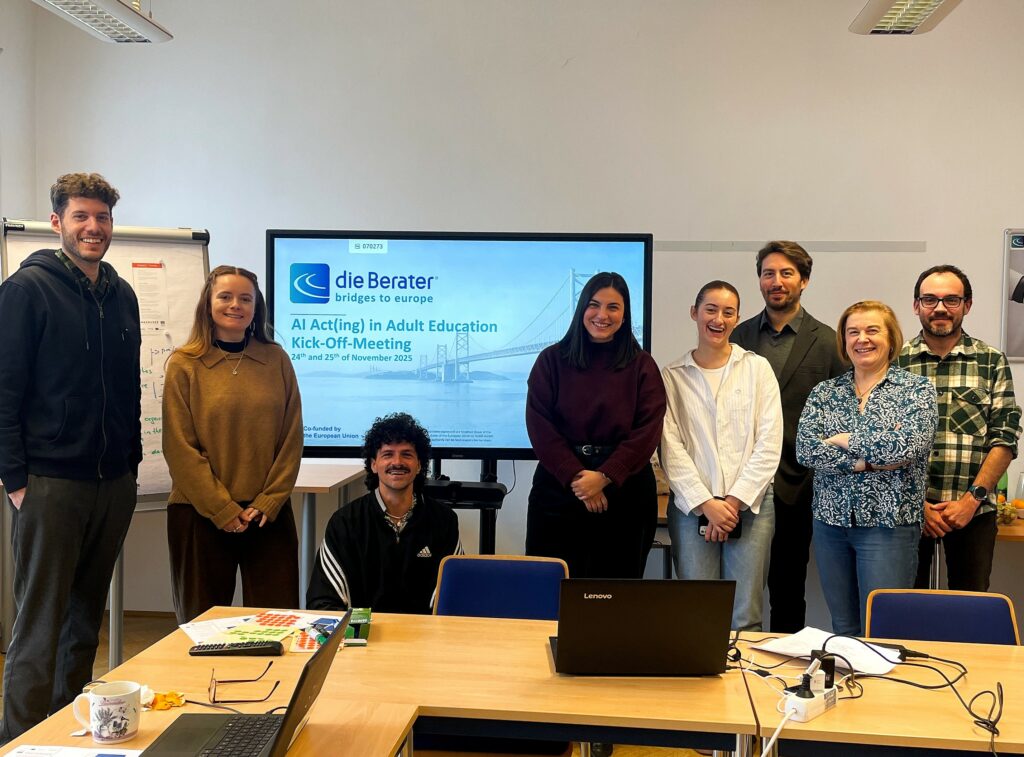
Back in November, we brought our consortium together for the official Kick-off Meeting in Vienna. It was more than a formal starting point, it was the moment where six organisations from across Europe aligned their perspectives, expectations, and expertise. From the very beginning, one thing stood out: while our partners come from different sectors, we share the same challenge. AI is already present in education, but structured support for educators is still catching up. The discussions during the meeting reflected exactly that. We did not spend time asking if AI matters. We focused on how we can make it usable, understandable, and responsible in real learning environments.
What we are working on right now: WP2 in action
At the moment, we are deep in the Research and Needs Analysis phase. And this is where things get particularly interesting. This phase is all about listening before creating. Together with our partners, we are:
- mapping the current state of AI use in adult education across Europe
- identifying gaps in AI knowledge and confidence among educators
- engaging directly with stakeholders through surveys, interviews, and discussions
Our goal is simple but crucial: we want to build everything that follows on real needs, not assumptions. And already, some patterns are emerging.
Early insights: more curiosity than confidence
The first findings from our Austrian stakeholder engagement activities give us a much clearer picture of where the Austrian sector currently stands.
On the one hand, AI is already widely used. A strong majority of educators report regular or occasional use of AI tools, especially for tasks like lesson planning, content creation, and information search. Many also highlight clear benefits: saving time, adapting materials more easily, and enriching their teaching approaches.
At the same time, this widespread use does not automatically translate into confidence. What we see instead is a clear gap between awareness and applied competence. While many educators describe themselves as familiar with AI concepts, a significant share feel only moderately confident when it comes to using AI responsibly in their work.
Several recurring challenges are emerging:
- Uncertainty around ethics and compliance, especially regarding data protection and the implications of the AI Act
- Concerns about quality and reliability, with educators pointing out that AI-generated content is not always accurate
- A lack of institutional guidance, with many organisations still developing or lacking clear AI policies
- The feeling of being overwhelmed by the speed of AI development and the growing number of tools available
At the same time, we are also seeing strong motivation across the sector. Educators are not stepping back. They are actively experimenting, reflecting, and looking for ways to use AI meaningfully.
One particularly interesting insight from interviews is that AI use often remains at a basic level, supporting existing tasks rather than transforming learning processes. Moving beyond this “tool use” towards more strategic and pedagogical integration will be a key step forward.
Why this matters now
The timing of AI Act(ing) in Adult Education could not be more relevant. With the European AI Act now shaping how organisations approach AI, adult education providers are facing new expectations. Educators are not only users of technology, they are mediators between technology and learners.
That means they need more than technical skills. They need orientation, critical thinking, and practical guidance.
This is exactly where our project comes in.
Based on the findings from WP2, we will move on to developing:
- a Guide to Responsible Use of AI in Adult Education
- a structured AI training course for educators
- open and accessible learning resources in multiple languages
Everything we build will be grounded in what educators actually need, and what they tell us right now.
What comes next
Over the coming months, we will continue gathering insights and consolidating results from across all partner countries. This will lead to a comprehensive transnational report that sets the foundation for the next steps.
At the same time, we will keep sharing updates, reflections, and behind-the-scenes moments from the project. Because for us, this is not just about delivering outputs. It is about shaping how AI is understood and used in adult education, together with the people who work in it every day.
Key takeaways
- We are three months into AI Act(ing) in Adult Education and already deep in research and stakeholder engagement
- Our Kick-off Meeting in November set a strong foundation for collaboration across six European partners
- AI is already widely used in adult education, but confidence and guidance are still catching up
- Work Package 2 ensures that all future outputs are based on real needs from the sector
- Next steps include developing a practical guide and training course for responsible AI use
Curious to follow our journey or get involved? We regularly share updates, insights, and opportunities to engage.
Learn more: https://ai-acting.eu/
Follow us on LinkedIn: https://www.linkedin.com/company/ai-acting/
Follow us on Facebook: https://www.facebook.com/profile.php?id=61585392836704