Janus+ Information Sheet

We are project partner in the EU-Project Janus+ which aims at learning, teaching and assessing soft skills in work-linked trainings. Find more information in the leaflet!

We are project partner in the EU-Project Janus+ which aims at learning, teaching and assessing soft skills in work-linked trainings. Find more information in the leaflet!
The Silver Age Silver Sage Initiative (SASSI for short) is a European-wide project tasked with developing an innovative, age-sensitive approach to Continuous Professional Development within organisations and in Vocational Education. Trainers, HR managers and employers can find all SASSI products developed and materials compiled to support the ageing workforce on the SASSI hub, the virtual meeting point of the project. This video summarizes the purpose of the project and serves as a guide for joining the SASSI hub.
For more information please visit the project website: sassi-project.eu.

There are a wide range of employment opportunities for languages graduates.
The international conference Crafting Employability Strategies for HE Students of Languages in Europe in Dublin on 7 September 2017 is an opportunity for careers professionals, employers, academic staff and teaching assistants of languages to explore how careers workshops could help third level students reach their career potential during and after university.
The Erasmus+ funded project CES&L adapted an existing Irish module for students of languages based on a needs analysis of employers of language graduates in Europe.
Workshops have been adapted by academic staff and career professionals in Europe for students of languages to assist them in their career decision making, exploring the future of work, the job search and making job applications. For more details, please see the brochure and agenda.
If you or your colleagues would like to attend this event, please register here.
Please email Elaine Browne at University College Cork if you have any further queries.

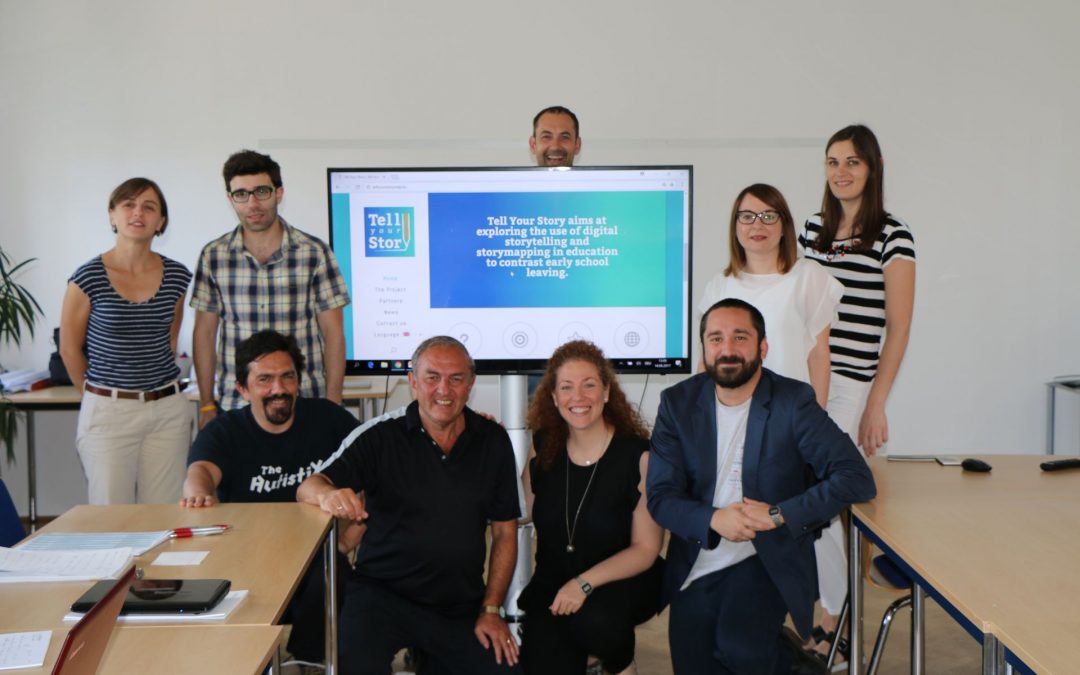
The second transnational meeting of the project Tell your story took place in Vienna on 14– 15 June 2017. The project consortium consisting of Pistes Solidaires (Project Coordinator, France), RIS Dvorec Rakičan (Slovenia), Rinova Limited (United Kingdom), EUROGEO VZW (Belgium) and CESIE (Italy) used the meeting to update each other on the project´s first results and reiterate the importance of storytelling in the fight against early school leaving.
Specifically, the scientific study “Telling digital stories to fight against early-school leaving” (which is our first project output) has been finalised. It summarizes the present state of research on the potential for story-telling and digital story mapping to engage young people at risk of drop out. It is available here.
Furthermore, the partnership carefully went through the next activities to be implemented, specifically regarding the development of the two learning modules (How to tell a life story & Media production skills).
Tell your story is a 2 years project co-financed by the Erasmus+ Programme, Key action 2 – Strategic Partnerships for adult education.
For further information on the project please visit tellyourstorymap.eu!

Continuous migration and flight as well as still high numbers of early school leaving bring big challenges for the education systems in Europe.
The conference will examine, how early school leaving and marginalisation of children and young people with migration or flight background can be prevented and how the integration into school and vocational education systems can succeed. Special focus will be given to the group of unaccompanied minor refugees.
| When: | October 19, 2017 (10 am – 4 pm) |
| Where: | TopLokal, Fleischmarkt 18, 1010 Vienna |
Detailed information will be published in the beginning of September. If you have any question please contact Franziska Steffen.
This event will take place in the frame of the European project ROBIN, which was co-financed by the Erasmus+ Programme of the European Union. ROBIN (Reinforcing cOmpetences to Build Inclusion through New learning methodologies) enhances the exchange of best practices between relevant education professionals and develops integrated training methods that bring together learning, coaching and support by means of psychosocial activities. The project was initiated and coordinated by Terre des hommes Romania, and carried out by five organisations active in the education and social sector from Austria, Bulgaria, Spain and Italy. The Austrian partner is die Berater Unternehmensberatungs GmbH. Click here for the Project-Flyer.

Soft skills are of great importance to successful entrepreneurship. We are project partner in the EU Project Janus+ which works among other things to raise awareness regarding the meaningful use of soft skills in the modern working reality.
Read more in the Janus+ Soft Skills Folder!

In 2018 will see the centennial of the end of World War I, which will trigger of numerous academic, and media activities. The project NETWORLD, funded by the European Commission’s Danube Transnational Programme (ERDF, IPA), has already started to engage with the architectural heritage of WWI.
In Austria and other countries along the Danube, many historical sites (frontline buildings, military premises, former war prisoner camps, memorial, other buildings with WWI relevance) can still be seen. Some of them have been thoroughly explored by research and made accessible to an interested public through museums or hiking paths. This has been accomplished in some cases by public authorities, more often by private history lovers and volunteers. Other sites, however , have hardly been looked after and are threatened by decay.
For the first time NETWORLD systematically maps this cultural heritage and develops strategies for its capitalization in tourism and education. At the time being, sites are researched, and their state of preservation and strategic development potentials are explored through interviews with experts and site managers. The results will be displayed in an online database which will allow interested users to access historical information and proposals for cultural touristic routes. Hopefully, this online tool will encourage people to engage with WWI and contribute to a joint European remembrance culture across borders and former frontlines.
Person and institutions who can support us in mapping and using unexplored WWI heritage are kindly invited to contact us and share their knowledge.
Project website: interreg-danube.eu/networld
The project is co-funded by European Union funds (ERDF, IPA)
interreg-danube.eu
The CES&L (Crafting Employability Strategies & Languages) project, funded by the European Union’s Erasmus+ programme, has worked with employers across Europe to seek their views on how Higher Education can support modern languages students to become more employable and recognise the significance of their degree in the international job market. This research has informed the adaptation of a generic Irish training course into a resource localised to, and translated for Bulgaria, Italy, Poland, the UK, and Ireland. die Berater® had the role to ensure that the employers’ perspective was adequately taken into account in all materials and co- developed a module on entrepreneurship competence.
Now project partner AHECS (Association of Higher Education Careers Services in Ireland) is organising an international conference to present and discuss the results of this innovative and exciting project in Trinity College Dublin, Ireland on 7 September 2017. Invited guests will gain an overview of the project process which took place over the last two years, hear feedback from participating European partners on their experience of engaging in this project and be able to participate in a demonstration of two workshops from this module focusing on best practice approaches to embedding employability within language teaching.
To support attendance at this event, AHECS offers five 200 Euro bursaries for international guests to assist with travel and accommodation. If you are interested in attending this conference, please email Elaine Browne, AHECS representative. The closing date for confirming attendance is 31 July 2017.
Project website: languages4work.eu
The project has been funded by the European Commission’s Erasmus+ programme.

The conference “Living a life to the fullest”, organised as part of the Erasmus+-funded project “Create your Future” organised by die Berater®’s partner company Catro Bulgaria in Sofia brought together employers, career counsellors, trainers and young people who have overcome childhood cancer. What they need is the chance to integrate in the labour market. The conference highlighted, however, not so much the restrictions and deficiencies caused by late effects from which some survivors may suffer but which can often be overcome by a few small support measures.
Testimonials of several former patients and encouraging integration and diversity strategies of multinational companies present at the conference demonstrated the enormous potential many of these young people have and can unfold for their employers. They have all learned to cope with a severe illness and are therefore often more mature, impressing and motivated personalities than many of their colleagues who have not faced such a challenge. A strong message worth spreading…
Information for employers and career counselling materials for professionals working with the target group can be downloaded at createyourfuture-eu.org.
The project has been funded by the European Commission’s Erasmus+ programme.

Higher education systems in post-communist regions like the Western Balkans and Russia are struggling with the fact that the most adventurous of their graduates tend to look for careers abroad and thus cause a brain drain damaging the countries’ prospects. Those young academics who are staying, on the contrary, often prefer low-paid but “safe” positions in the public sector to insecure but perhaps more rewarding entrepreneurial careers. The Erasmus+ Capacity Building project REBUS aims at enhancing entrepreneurial mind-sets and competences of graduates of engineering and ICT study programmes.
At a project meeting at the University of Sarajevo results of a comparative study on existing entrepreneurship initiatives and training needs of university students were presented and discussed. On the basis of these findings innovative competence development programmes will be developed and piloted next year. As diverse the findings were, one thing became evident: There is a clearly identified need for new forms of entrepreneurship learning outside educational institutions: projects, mentoring, simulations, internships etc. An entrepreneurial mind is best nurtured in the fresh air of the world of business!
Visit our Project website: rebusproject.net
The project has been funded by the European Commission’s Erasmus+ programme.