Categories
Project Updates

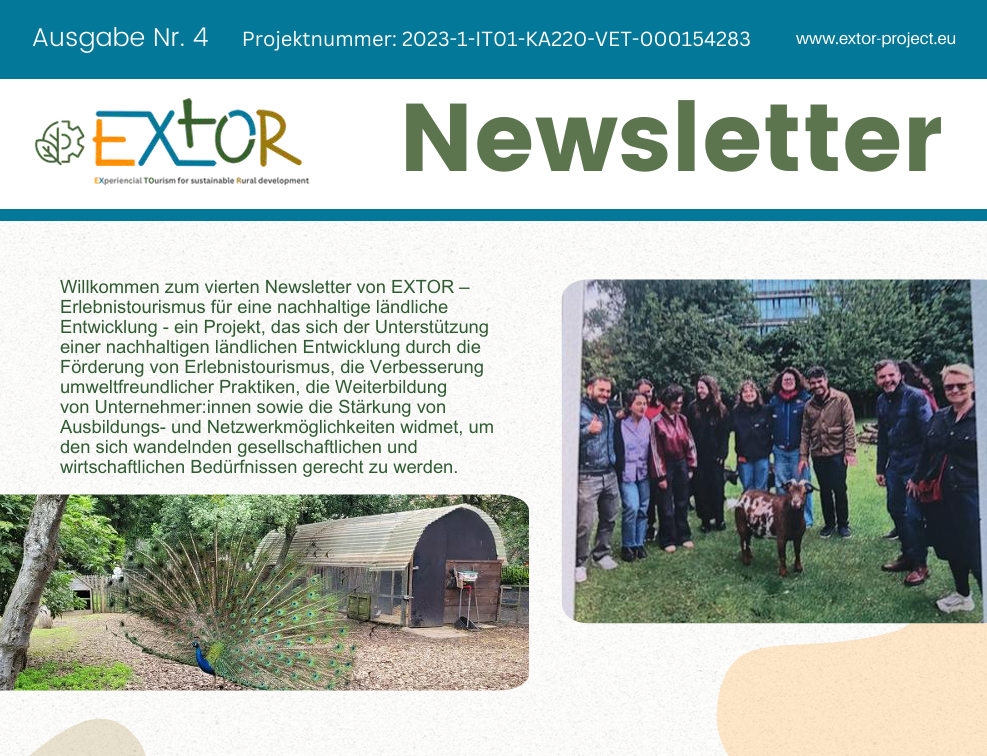
EXTOR-Newsletter: Neue Impulse für nachhaltigen Erlebnistourismus in ländlichen Räumen

Im Mittelpunkt steht eine Frage, die für viele ländliche Regionen besonders relevant ist: Wie können wir Tourismusangebote entwickeln, die nicht nur attraktiv für Besucher:innen sind, sondern auch lokale Betriebe, Gemeinden, Bildungsanbieter und regionale Netzwerke stärken? Genau hier setzt EXTOR an. Das Projekt beschäftigt sich mit nachhaltigem Erlebnistourismus als Chance für ländliche Räume – praxisnah, zukunftsorientiert und mit Blick auf jene Menschen, die vor Ort Angebote gestalten, vermitteln und weiterentwickeln.

Der Newsletter gibt Einblicke in die aktuellen Entwicklungen des Projekts und macht sichtbar, welche Ergebnisse in den vergangenen Monaten entstanden sind. Dazu zählen Aktivitäten, Materialien und Impulse, die Unternehmer:innen, Bildungsanbieter und regionale Akteur:innen dabei unterstützen können, nachhaltige touristische Erlebnisse zu planen und umzusetzen. Es geht dabei nicht um Tourismus als kurzfristigen Trend, sondern um Angebote, die zur Region passen, lokale Ressourcen respektieren und langfristig Nutzen stiften.

Für Unternehmer:innen im ländlichen Raum bietet EXTOR wertvolle Anregungen, wie Erlebnisse authentisch, wirtschaftlich tragfähig und nachhaltig gestaltet werden können. Gerade kleinere Betriebe stehen oft vor der Herausforderung, sich klar zu positionieren und gleichzeitig mit begrenzten Ressourcen zu arbeiten. Nachhaltiger Erlebnistourismus kann hier neue Möglichkeiten eröffnen: durch stärkere regionale Zusammenarbeit, durch Angebote mit klarer Geschichte und Identität und durch ein besseres Verständnis dafür, was Gäste heute suchen.

Auch für Bildungsanbieter ist der Newsletter interessant. Die im Projekt erarbeiteten Erkenntnisse können in Trainings, Workshops und Lernformate einfließen und so dazu beitragen, Kompetenzen im Bereich nachhaltiger Tourismusentwicklung aufzubauen. Das ist besonders wichtig, weil gute Ideen allein nicht ausreichen. Menschen brauchen Wissen, Werkzeuge und Beispiele, um neue Ansätze in die Praxis zu bringen. EXTOR liefert dafür eine gute Grundlage.

Regionale Akteur:innen – von Gemeinden über Entwicklungsagenturen bis hin zu Tourismusorganisationen – finden im Newsletter ebenfalls relevante Impulse. Nachhaltiger Erlebnistourismus funktioniert dann besonders gut, wenn verschiedene Partner:innen zusammenarbeiten und gemeinsame Ziele verfolgen. Ländliche Räume verfügen oft über starke kulturelle, natürliche und soziale Ressourcen. Die Herausforderung liegt darin, diese Ressourcen so zu nutzen, dass sie nicht überlastet werden, sondern erhalten bleiben und zugleich neue Chancen für die Region schaffen.

Mit dem bevorstehenden Abschluss des Projekts rückt auch die langfristige Nutzung der Ergebnisse in den Vordergrund. Die im Projekt gewonnenen Erkenntnisse und Materialien stehen weiterhin kostenlos zur Verfügung. Damit können sie auch nach Projektende genutzt werden – etwa für die Entwicklung neuer Tourismuskonzepte, für Bildungsmaßnahmen oder für regionale Strategien im Bereich nachhaltiger Erlebnisse.

Der aktuelle Newsletter ist daher mehr als ein Rückblick auf Projektaktivitäten. Er ist eine Einladung, die Ergebnisse von EXTOR kennenzulernen, daraus Ideen mitzunehmen und sie in den eigenen Kontext zu übertragen. Ob Betrieb, Bildungseinrichtung oder regionale Organisation: Wer nachhaltige Tourismusangebote in ländlichen Räumen stärken möchte, findet darin wertvolle Anknüpfungspunkte.

Kurz vor dem Projektabschluss freuen wir uns besonders darüber, dass EXTOR nicht einfach endet, sondern weiterwirken kann. Die entwickelten Inhalte, Erfahrungen und Ergebnisse bleiben verfügbar und können dazu beitragen, nachhaltigen Erlebnistourismus in Europa weiter voranzubringen. Genau das war von Beginn an unser Ziel: Wissen schaffen, Praxis unterstützen und ländliche Regionen dabei begleiten, ihre eigenen Stärken sichtbar und erlebbar zu machen.

Wer mehr über die aktuellen Projektergebnisse und Aktivitäten erfahren möchte, sollte einen Blick in den neuen EXTOR-Newsletter werfen.

 

Categories
Project Updates

DIGINEXT-Ergebnisse zur digitalen Inklusion jetzt öffentlich zugänglich

Nach zwei Jahren intensiver Zusammenarbeit geht das europäische Projekt DIGINEXT zu Ende. Gemeinsam mit Partnerorganisationen aus Spanien, Italien, Griechenland, Österreich und Rumänien haben wir daran gearbeitet, die digitale Inklusion in ländlichen Gebieten zu stärken und neue Perspektiven für die Erwachsenenbildung und regionale Entwicklung zu schaffen. Die im Projekt entwickelten Ergebnisse sind nun öffentlich verfügbar.

DIGINEXT stand für den Aufbau nachhaltiger Strukturen, um insbesondere Senior:innen und gering qualifizierte Personen in ländlichen Regionen beim Zugang zur digitalen Welt zu unterstützen. Im Mittelpunkt stand die Frage, wie digitale Teilhabe langfristig gefördert werden kann – nicht nur durch einzelne Schulungen, sondern durch praxistaugliche Instrumente, neue Rollenprofile und übertragbare Bildungsansätze.

Ein zentrales Ergebnis des Projekts ist das Berufsbild der Fachkraft für digitale Inklusion im ländlichen Raum. Damit wird eine neue Rolle beschrieben, die Menschen in ländlichen Gemeinden dabei unterstützt, digitale Angebote besser zu nutzen und an gesellschaftlichen Entwicklungen teilzuhaben. Das Berufsbild macht zugleich sichtbar, welche Kompetenzen künftig gebraucht werden, um digitale Inklusion vor Ort wirksam zu gestalten.

Darüber hinaus wurde ein modular aufgebauter Schulungskurs entwickelt, der digitale Kompetenzen stärkt und Themen wie den Zugang zu Online-Diensten, E-Health und digitale Nachhaltigkeit aufgreift. Ergänzt wird dieser durch einen Train-the-Trainer-Ansatz, der Fachkräften in der Erwachsenenbildung und lokalen Aktionsgruppen ermöglicht, die Inhalte flexibel weiterzugeben und an regionale Bedürfnisse anzupassen.

Besonders wertvoll sind auch die Erfahrungen aus den Pilotprojekten und Evaluationen. Das dort gesammelte Feedback zeigt, dass die entwickelten Materialien als benutzerfreundlich, relevant und wirksam wahrgenommen wurden. Damit liefert DIGINEXT nicht nur theoretische Konzepte, sondern konkrete und erprobte Ansätze für die Praxis in ländlichen Regionen Europas.

Für uns bei bridges to europe zeigt DIGINEXT einmal mehr, wie wichtig europäische Zusammenarbeit ist, wenn es darum geht, gesellschaftliche Herausforderungen gemeinsam anzugehen. Digitale Teilhabe ist eine zentrale Voraussetzung für Chancengerechtigkeit, gesellschaftliche Beteiligung und ein selbstbestimmtes Leben – gerade in ländlichen Räumen. Die Projektergebnisse bieten dafür wertvolle Impulse und praktische Werkzeuge.

Wir laden Pädagog:innen, politische Entscheidungsträger:innen, Akteur:innen der ländlichen Entwicklung und Fachkräfte der Erwachsenenbildung herzlich ein, die Ergebnisse kennenzulernen und weiterzutragen. Gemeinsam können wir dazu beitragen, ländliche Räume in Europa inklusiver, resilienter und digital zugänglicher zu gestalten.

Categories
Allgemein Project Updates

Learning a Language With AI: What We Discovered in the UNITE AI Workshop

There’s more than one way to learn a language today. Some people thrive in a classic face-to-face course, others prefer the flexibility of online tools they can use whenever it suits them — and more recently, thanks to the rapid development of AI tools, a third option has emerged: learning with AI. As part of UNITE’s learning activities, we wanted to explore what this newest option can actually offer, and it turns out there is now a solid body of research backing up this approach.

As part of the Austrian pilot phase, we ran the AI workshop on two dates, 19 March and 2 April 2026. The first session laid the groundwork, introducing participants to what AI actually is and how it works, in plain, accessible language. The second session then turned hands-on: together with the participants, we worked out practical, everyday ways to use AI tools to improve their German language skills — in a way that felt natural and easy to fit into daily life, rather than like an obligation on top of an already full plate.

And by the way, several recent meta-analyses point to a measurable positive effect of AI chatbots on second-language acquisition, with generative AI tools performing notably better than simple, rule-based chatbots. One review of nearly 50 studies found that AI-supported learning is particularly effective for listening and speaking comprehension — exactly the skills that matter most for everyday interactions at work, at the doctor’s office, or with a landlord.

A few mechanisms help explain why this works so well. First, individualisation and availability: unlike a course with a fixed timetable, an AI language tool adapts to a person’s level, pace, and interests, and is available regardless of time or place. Research on self-determination shows that this kind of autonomy — being able to choose what, when, and how to practise — meaningfully increases both willingness to speak and overall motivation to learn.

Second, short and regular practice sessions consistently outperform occasional long study sessions, a finding known as “spaced practice” and one of the most robust results in learning psychology. The AI workshop leans into this directly, encouraging participants to complete short, regular exercises rather than saving language learning for rare, lengthy sessions.

Third, feedback matters enormously. Corrective feedback is one of the most thoroughly researched areas in second-language acquisition, and studies consistently show a stable, moderate positive effect on language learning — an effect that is often even stronger for people learning a language in a country where it isn’t yet widely spoken around them. An AI tool that gives feedback immediately after every exercise offers a level of responsiveness that a single teacher, working with a group, simply cannot match.

Finally, and perhaps most importantly for people learning a language during an emotionally difficult chapter of their lives: several recent studies show that AI chatbots reduce speaking anxiety, because they offer a judgement-free space to practise without social pressure. Being able to speak repeatedly without fear of embarrassment measurably increases people’s willingness to use a new language at all.

That said, the research is equally clear about the limits of this method. AI systems still show limited emotional sensitivity and contextual understanding, which makes them less suited to tasks requiring empathy or nuanced interpretation. This is exactly why the AI workshop is not designed to replace other language learning opportunities, but to complement them — an additional tool, available any time, within a much broader support system.

__________________________________________________

Co-funded by the European Union. Views and opinions expressed are however those of the author(s) only and do not necessarily reflect those of the European Union or the Social Innovation Initiative. Neither the European Union nor the Social Innovation Initiative can be held responsible for them.

Categories
Project Updates

DIGINEXT: Die Projektergebnisse sind jetzt verfügbar

Wir freuen uns, die Ergebnisse des europäischen Projekts DIGINEXT vorzustellen. In den vergangenen zwei Jahren haben wir gemeinsam mit unseren Partner:innen daran gearbeitet, digitale Teilhabe und Inklusion in ländlichen Räumen zu stärken.

Ab sofort sind zentrale Projektergebnisse verfügbar. Dazu gehören das DIGINEXT Professional Profile, ein Trainingskurs mit begleitendem Handbuch sowie die Ergebnisse der abgeschlossenen Pilotphase. Gemeinsam zeigen sie, wie ältere Menschen und Menschen mit geringeren digitalen Vorkenntnissen in ländlichen Regionen besser unterstützt werden können.

Mit DIGINEXT setzen wir ein Zeichen für mehr digitale Teilhabe und Inklusion in Europa.

Mehr zu den Ergebnissen und den letzten Newsletter findet ihr hier als Download oder unterhalb eingebettet.

Categories
Project Updates

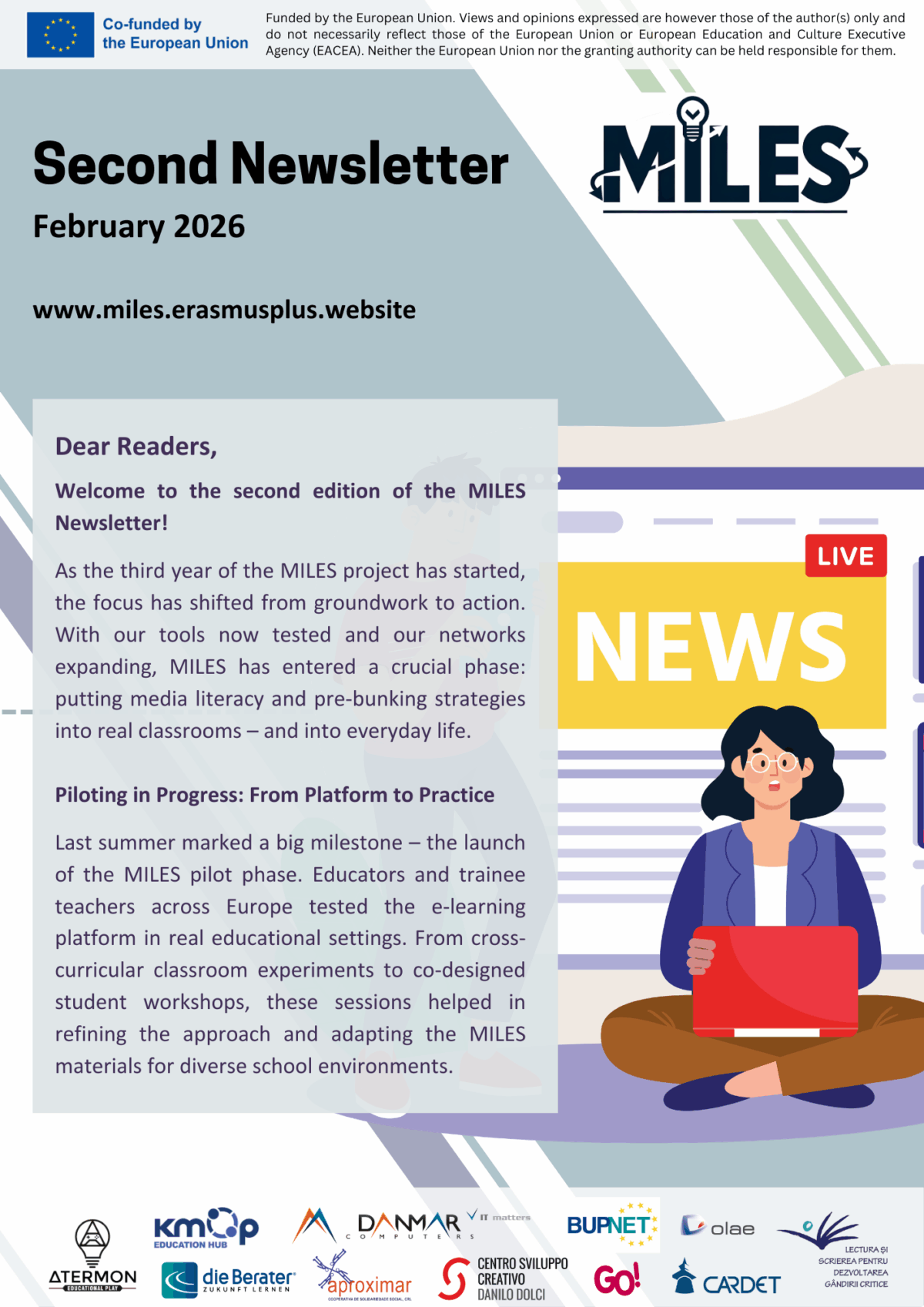
MILES third Newsletter: From Pilots to Playful Learning

We’re excited to share MILES Newsletter #3—a snapshot of how the project is moving from planning and testing to real classroom action across Europe.

As we enter the third year of MILES, our focus is clear: media literacy and pre-bunking strategies need to be practical, engaging, and easy to use in everyday educational settings. In this new edition, we highlight what we’ve learned so far, what’s happening right now in schools, and what’s coming next.

What you’ll find in our third Newsletter:

Piloting insights that matter: Educators and trainee teachers have been testing the MILES platform and materials in real learning environments. Their feedback helps us strengthen usability, improve facilitation, and make sure our approach works across different classroom realities.

Student pilots in 2026: Across partner countries, teachers are now piloting the developed materials directly with students. A simple pre- and post self-assessment supports this phase by capturing changes in students’ confidence and skills—especially in recognising misleading content and navigating online information more critically.

Vienna partner meeting highlights: In early February 2026, we met with the full consortium in Vienna to review piloting results and align on next steps. The goal: ensure what we build is not only pedagogically sound, but also genuinely usable for teachers and future participants.

A big next step: board games! One of the most energising topics in the project right now is the upcoming board game phase. Students will turn their learning into playful formats that make pre-bunking strategies shareable—sparking conversations that travel beyond the classroom into peer groups, families, and communities.

We invite educators, organisations, and policy stakeholders to explore what’s inside and see how MILES can support inclusive, critical, and confident engagement with information—online and offline.

Read MILES third Newsletter here

Categories
Allgemein Project Updates

Early Lessons from the UNITE Pilot: Reaching the People Who Need Us Most

When the Austrian pilot phase of UNITE launched in November 2025, we expected many things to be challenging. One thing we had not fully anticipated was simply finding the right people to reach.

Die Berater’s day-to-day work happens largely within the AMS (Arbeitsmarktservice) context, supporting people who are registered as jobseekers. UNITE, however, is meant for a much broader group: any person who fled Ukraine and is looking to build a professional future in Austria, whether or not they are currently registered with the AMS. Many people who could benefit most from coaching, mentoring, and learning support are simply not visible through the usual channels — they may not yet be job-seeking, may be occupied with childcare or family responsibilities, or may not know that a programme like UNITE exists at all.

So, in the early weeks of the pilot, much of our energy went into something that happens behind the scenes of any project: building relationships. We reached out to a wide range of stakeholders — community organisations, integration initiatives, language schools, and informal networks within the Ukrainian community in Austria — to make sure that UNITE becomes visible and accessible to everyone who could benefit from it, not only to those already in contact with employment services. This is particularly important because UNITE, thanks to its EU funding, is entirely free of charge for participants.

As the first participants joined the programme, another lesson quickly became clear: the topics people bring with them vary enormously. Some arrive wanting to know precisely which additional qualification they need to have their profession recognised in Austria. Others are still processing the abruptness of their departure from Ukraine and need space before career planning can even begin. Some are confident jobseekers looking for a sparring partner; others have never navigated a foreign job market and don’t know where to start. There is no “typical” UNITE participant — and that diversity is exactly why the project’s flexible, person-centred design matters so much in practice, not just on paper.

These early experiences have shaped how we approach outreach and intake going forward, and they have reinforced something we already suspected: reaching people well is just as important as the support we offer once they arrive. In our next post, we will share insights from another important part of UNITE — the exchange happening between coaches and mentors across all four partner countries.

___________________________________________________

Co-funded by the European Union. Views and opinions expressed are however those of the author(s) only and do not necessarily reflect those of the European Union or the Social Innovation Initiative. Neither the European Union nor the Social Innovation Initiative can be held responsible for them.

Categories
Allgemein Project Updates

Introducing UNITE: A New EU Project Supporting Ukrainian Refugees Into Employment

Since February 2022, millions of people have fled Ukraine, arriving in
countries that offer safety but rarely the professional standing, network, or
sense of home they left behind. UNITE – Ukrainian Newcomer’s Integration
Towards Employment – is a new ESF+-funded project designed to close exactly
that gap. Over the coming months, our team at die Berater Unternehmensberatung
will be sharing regular updates from the project here on our blog, and we
wanted to start by introducing what UNITE is all about.

UNITE brings together partner organisations from Sweden, Poland,
Germany, and Austria, each contributing local expertise while working from a
shared methodology. The project combines three elements — coaching, mentoring,
and learning activities — to support people who fled Ukraine in finding their
footing in a new labour market. As the Austrian partner, die Berater brings
years of experience in career orientation and coaching to the table, adapting
an approach that has already shown strong results elsewhere to the specific
realities of the Austrian labour market and social system.

In May 2026, all four project partners travelled to Copenhagen for a
study visit to Væksthuset, a Danish institution that combines labour market
training, facilitator competence development, and research under one roof.
Danish research and practice make a compelling case for how integration support
can be made more effective: rather than addressing language learning, labour
market preparation, health, and civic orientation one after another, treating
them together — as interconnected parts of the same process — has proven far
more successful than a purely sequential approach.

The visit gave our team, together with colleagues from Sweden, Poland,
and Germany, direct insight into a model that has already supported many people
successfully into employment and education. We spent the days observing
sessions, discussing methodology with facilitators, and exchanging ideas on how
these insights can be translated into each partner country’s own context —
because what works in Copenhagen cannot simply be copied elsewhere; it needs to
be adapted to different labour markets, different institutions, and different
starting points.

These inspiring insights are now being built into an innovative
integration programme for people who fled Ukraine, tailored specifically to the
Austrian context. The programme is set to start this autumn, and we are already
looking forward to sharing more about its content, and about the people it will
support, in the coming months.

Stay tuned for our next post, where we will look more closely at what
coaching, mentoring, and learning activities actually look like within UNITE 
and why combining all three matters so much.


____________________________________________________________

Co-funded by the European
Union. Views and opinions expressed are however those of the author(s) only and
do not necessarily reflect those of the European Union or the Social Innovation
Initiative. Neither the European Union nor the Social Innovation Initiative can
be held responsible for them.

Categories
Allgemein Project Updates

MILES 1st Newsletter

MILES 1st Newsletter

In today’s digital world, fake news and false information are growing problems. 

MILES helps teachers promote critical thinking and deal with disinformation. It also helps students navigate online information safely.

The program will start in Austrian schools in April 2025 and run until the end of the year.

1. Newsletter

Categories
Allgemein Project Updates

Be Inclusive! First Newsletter out now

Be Inclusive! First Newsletter out now

The Be Inclusive! consortium produced their first Newsletter and it is now available!

For more updates on the project, follow us on Facebook  or on our project website
 

Categories
Allgemein Project Updates

The Be Inclusive! Brochure is out now

The Be Inclusive! Brochure is out now

Exciting news from the Be Inclusive consortium: Our Brochure is now available in all partner languages!

The Brochure consists of four key parts:

  1. National Context introduction with an overview of each national context of the 8 countries involved
  2. Policies, identifying the main policy approach in each partner country
  3. Needs, specifying the different needs at national level both for people with disabilities and SMEs
  4. Best Practices: lessons learned coming from the involved partner countries on inclusion in SMEs

By gathering national researches from 8 countries provided by project partners from Germany, Austria, Slovenia, Italy, Greece, Belgium, Latvia and Switzerland, this document gives an overview of the current situation of persons with disabilities in the labor market at European level. As it will be shown in the following pages, the document will give insights and define national frameworks, thus being a good first step on that area where SMEs and people with disabilities meet each other.

 Download the Brochure here and take a look on our website: https://www.be-inclusive.net/results/ and stay updated on our upcoming project results!