Categories
Allgemein

UNITE Pilot Phase: A First Look at the Numbers and the Stories Behind Them

As the Austrian pilot phase of UNITE draws to a close, it’s a good moment to take stock of what the past months have shown us — both in numbers and in the stories behind them.
In total, 35 people took part in the Austrian pilot, and no two paths looked alike. The group ranged from an 18-year-old who had just finished school to a mother of two, and even included a participant with a doctoral degree. One pattern stood out immediately: 34 of the 35 participants were women, with only one male participant, who was still a minor at the time he fled. This is not a coincidence — it directly reflects Ukrainian martial law, which since February 2022 has generally prohibited men of conscription age (18 to 60) from leaving the country. As a result, those who were able to flee were overwhelmingly women, minors, or people past retirement age, a pattern that mirrors the demographics seen across nearly all European host countries.
Education levels among participants were strikingly high: one person held vocational training, four had completed their Matura (Austrian school-leaving qualification), four held a Bachelor’s degree, 25 held a Master’s degree, and one held a PhD. In other words, more than 80 percent of participants held an academic qualification, many at the highest level. This mirrors broader international data, and it underlines a point we find ourselves returning to again and again: what leaves Ukraine is not a lack of qualification, but highly qualified potential that, without the right support, risks going unused in a new country.
The age range was similarly broad — from participants aged 18 to those in their early sixties — and 14 of the 35 participants had children, a factor that significantly shapes how much time and energy someone can realistically dedicate to job searching, further training, or coaching sessions. Despite this diversity, one consistent pattern emerged across almost every participant’s journey: German language skills are among the single most important factors for successfully entering the Austrian labour market, regardless of how strong someone’s prior qualifications are. Being able to communicate confidently is often what determines whether a qualification can actually be put to use.
Perhaps the clearest takeaway from the pilot phase is this: there is no single path back into professional life after displacement. Some participants needed practical tools — a CV in the local format, a clear overview of recognition procedures. Others needed space to process what they had been through before career planning could even begin. What UNITE’s pilot phase has shown, above all, is that flexibility is not a nice extra — it is the whole point.

___________________________________________________

Co-funded by the European Union. Views and opinions expressed are however those of the author(s) only and do not necessarily reflect those of the European Union or the Social Innovation Initiative. Neither the European Union nor the Social Innovation Initiative can be held responsible for them.

Categories
Allgemein

Coaches and Mentors Compare Notes: What We Learned in UNITE

UNITE brings together coaches and mentors who work closely with people navigating a genuinely difficult life transition. Supporting people who have recently fled a war, and who are navigating an unfamiliar country while carrying real uncertainty about their future, means that difficult and emotionally heavy topics come up regularly in coaching sessions. That is precisely why the exchange between coaches and mentors across the four partner countries — Sweden, Poland, Germany, and Austria — has become such a valuable part of the project.

So far, two online meetings have brought together coaches and mentors from all partner organisations. These sessions gave everyone involved the chance to compare notes: what challenges are coaches in other countries facing? How do mentors in Poland handle situations that feel similar to ones we’ve encountered in Austria? What has worked well, and what hasn’t? For a role that can otherwise feel quite solitary — sitting one-on-one with someone navigating a genuinely difficult life transition — this kind of peer exchange offers real relief, as well as practical ideas that can be brought straight back into everyday work with participants.

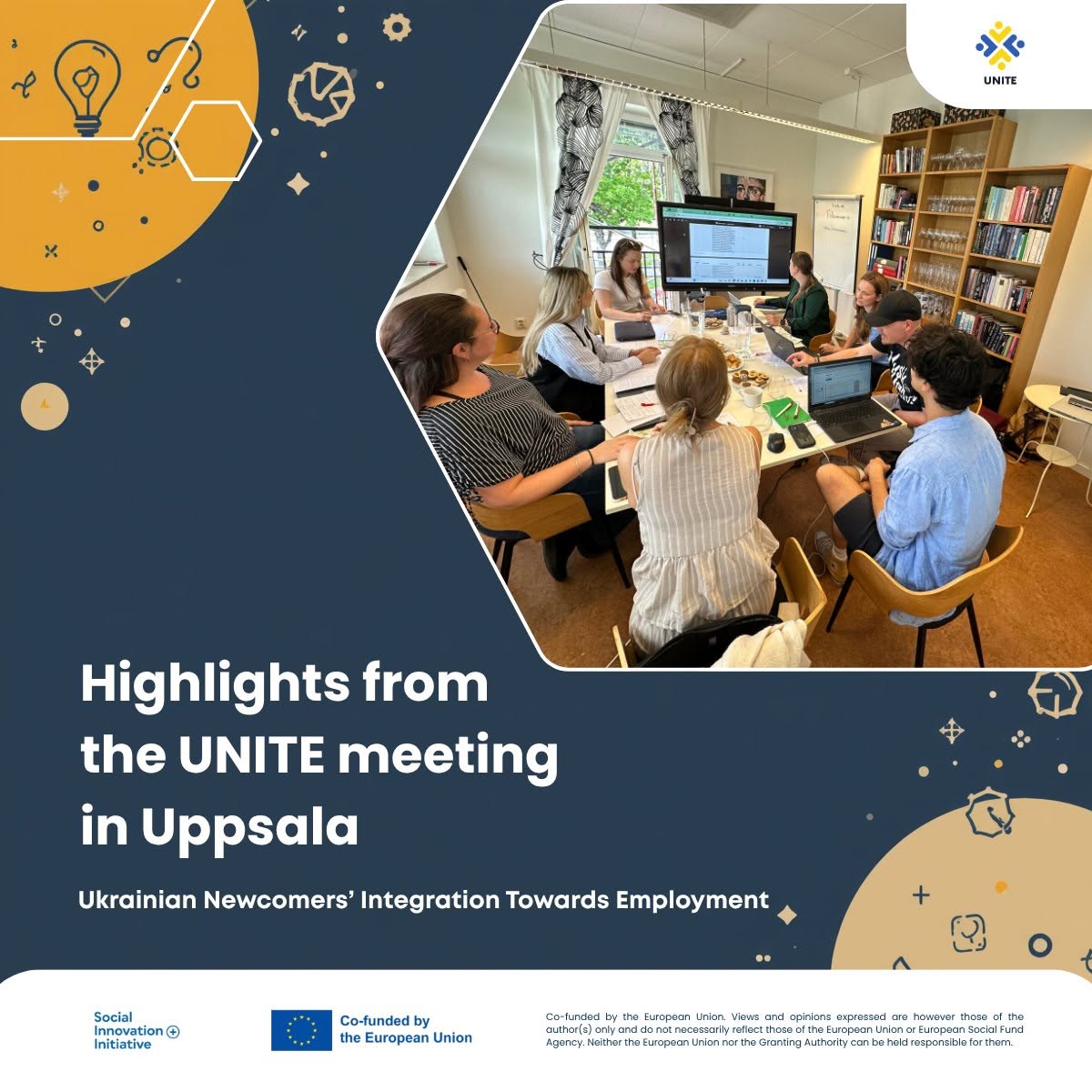
In June 2026, this exchange took a further step: coaches and mentors from all four countries met in person in Uppsala, Sweden, for a face-to-face meeting hosted by our Swedish project partner. Meeting colleagues in person, after months of collaborating primarily online, added a different quality to the conversations — more room for nuance, for informal exchange during breaks, and for building the kind of trust that makes future collaboration easier.

Beyond the practical exchange of experience, one outcome of the Uppsala meeting stood out clearly: everyone in the room agreed that UNITE matters. Across four countries and very different national contexts, coaches and mentors independently arrived at the same conclusion — that this project creates a genuine social impact for the people it supports, and that the work, while demanding, is deeply worthwhile.

These meetings are a reminder that a project like UNITE is not just about the tools and methodologies it uses, but about the people delivering it — and about making sure they, too, are supported, connected, and able to learn from one another across borders. As the pilot phase draws to a close, we will share a summary of what it revealed in our next post.

Abstract

Two online meetings and a face-to-face gathering in Uppsala brought together UNITE coaches and mentors from four countries. We share what came out of these exchanges — and why everyone in the room agreed that this project creates real, tangible social impact.

_____________________________________________________

Co-funded by the European Union. Views and opinions expressed are however those of the author(s) only and do not necessarily reflect those of the European Union or the Social Innovation Initiative. Neither the European Union nor the Social Innovation Initiative can be held responsible for them.

Categories
Allgemein

Just Talk: Inside UNITE’s German Language Cafés

Of all the elements that make up UNITE’s learning activities, the German language cafés might be the simplest in concept — and yet, for many participants, they turn out to be one of the most valuable. There’s no textbook to work through, no grade at the end, no right or wrong way to take part. The idea is refreshingly straightforward: come together, and talk.

Our first language café took place on 15 April, led by Jo Galletly, a long-standing trainer at die Berater with years of experience helping people build the confidence to actually use a new language, not just study it. Rather than working through grammar exercises or vocabulary lists, the sessions focus on everyday, practical German — the kind of language people need for a conversation at the doctor’s office, a chat with a neighbour, or a phone call to sort out an appointment. It’s German for real life, not for a test.

What makes the language cafés work, though, isn’t just the content — it’s the atmosphere. Anyone who has tried to learn a new language as an adult knows how quickly the fear of making mistakes can shut a person down. It’s often easier to stay quiet than to risk saying something wrong out loud. So the cafés are deliberately designed to feel relaxed and low-pressure: a space where participants can speak freely, even if a sentence isn’t perfect, without worrying about being corrected mid-thought or judged for an accent. The goal in the moment is simply to talk — to get words out, to be understood, to have an actual conversation.

Only afterwards does the group turn to reflection and feedback. Once a conversation has run its course, Jo and the participants look back together at what came up: which phrases worked well, where something got lost in translation, what could be said differently next time. This sequence — speak first, refine second — matters more than it might seem. It means participants build real speaking fluency and confidence before, rather than instead of, working on precision. Over time, this combination of relaxed practice and thoughtful feedback lets participants improve in a way that feels sustainable rather than stressful.

There’s also something that happens in these sessions that goes beyond language practice itself. The language café brings people together who are navigating very similar situations — a new country, a new everyday language, often a lot of uncertainty in between. Simply having a regular, easy-going space to show up, talk, and be around others in the same boat turns out to matter almost as much as the German practice itself. It’s a small, weekly reminder that nobody is doing this alone.

We’re looking forward to continuing the language cafés throughout the pilot phase, and to sharing more of what participants take away from them as the sessions continue.

______________________________________________________

Co-funded by the European Union. Views and opinions expressed are however those of the author(s) only and do not necessarily reflect those of the European Union or the Social Innovation Initiative. Neither the European Union nor the Social Innovation Initiative can be held responsible for them.

Categories
Allgemein Project Updates

Learning a Language With AI: What We Discovered in the UNITE AI Workshop

There’s more than one way to learn a language today. Some people thrive in a classic face-to-face course, others prefer the flexibility of online tools they can use whenever it suits them — and more recently, thanks to the rapid development of AI tools, a third option has emerged: learning with AI. As part of UNITE’s learning activities, we wanted to explore what this newest option can actually offer, and it turns out there is now a solid body of research backing up this approach.

As part of the Austrian pilot phase, we ran the AI workshop on two dates, 19 March and 2 April 2026. The first session laid the groundwork, introducing participants to what AI actually is and how it works, in plain, accessible language. The second session then turned hands-on: together with the participants, we worked out practical, everyday ways to use AI tools to improve their German language skills — in a way that felt natural and easy to fit into daily life, rather than like an obligation on top of an already full plate.

And by the way, several recent meta-analyses point to a measurable positive effect of AI chatbots on second-language acquisition, with generative AI tools performing notably better than simple, rule-based chatbots. One review of nearly 50 studies found that AI-supported learning is particularly effective for listening and speaking comprehension — exactly the skills that matter most for everyday interactions at work, at the doctor’s office, or with a landlord.

A few mechanisms help explain why this works so well. First, individualisation and availability: unlike a course with a fixed timetable, an AI language tool adapts to a person’s level, pace, and interests, and is available regardless of time or place. Research on self-determination shows that this kind of autonomy — being able to choose what, when, and how to practise — meaningfully increases both willingness to speak and overall motivation to learn.

Second, short and regular practice sessions consistently outperform occasional long study sessions, a finding known as “spaced practice” and one of the most robust results in learning psychology. The AI workshop leans into this directly, encouraging participants to complete short, regular exercises rather than saving language learning for rare, lengthy sessions.

Third, feedback matters enormously. Corrective feedback is one of the most thoroughly researched areas in second-language acquisition, and studies consistently show a stable, moderate positive effect on language learning — an effect that is often even stronger for people learning a language in a country where it isn’t yet widely spoken around them. An AI tool that gives feedback immediately after every exercise offers a level of responsiveness that a single teacher, working with a group, simply cannot match.

Finally, and perhaps most importantly for people learning a language during an emotionally difficult chapter of their lives: several recent studies show that AI chatbots reduce speaking anxiety, because they offer a judgement-free space to practise without social pressure. Being able to speak repeatedly without fear of embarrassment measurably increases people’s willingness to use a new language at all.

That said, the research is equally clear about the limits of this method. AI systems still show limited emotional sensitivity and contextual understanding, which makes them less suited to tasks requiring empathy or nuanced interpretation. This is exactly why the AI workshop is not designed to replace other language learning opportunities, but to complement them — an additional tool, available any time, within a much broader support system.

__________________________________________________

Co-funded by the European Union. Views and opinions expressed are however those of the author(s) only and do not necessarily reflect those of the European Union or the Social Innovation Initiative. Neither the European Union nor the Social Innovation Initiative can be held responsible for them.

Categories
Allgemein Project Updates

Early Lessons from the UNITE Pilot: Reaching the People Who Need Us Most

When the Austrian pilot phase of UNITE launched in November 2025, we expected many things to be challenging. One thing we had not fully anticipated was simply finding the right people to reach.

Die Berater’s day-to-day work happens largely within the AMS (Arbeitsmarktservice) context, supporting people who are registered as jobseekers. UNITE, however, is meant for a much broader group: any person who fled Ukraine and is looking to build a professional future in Austria, whether or not they are currently registered with the AMS. Many people who could benefit most from coaching, mentoring, and learning support are simply not visible through the usual channels — they may not yet be job-seeking, may be occupied with childcare or family responsibilities, or may not know that a programme like UNITE exists at all.

So, in the early weeks of the pilot, much of our energy went into something that happens behind the scenes of any project: building relationships. We reached out to a wide range of stakeholders — community organisations, integration initiatives, language schools, and informal networks within the Ukrainian community in Austria — to make sure that UNITE becomes visible and accessible to everyone who could benefit from it, not only to those already in contact with employment services. This is particularly important because UNITE, thanks to its EU funding, is entirely free of charge for participants.

As the first participants joined the programme, another lesson quickly became clear: the topics people bring with them vary enormously. Some arrive wanting to know precisely which additional qualification they need to have their profession recognised in Austria. Others are still processing the abruptness of their departure from Ukraine and need space before career planning can even begin. Some are confident jobseekers looking for a sparring partner; others have never navigated a foreign job market and don’t know where to start. There is no “typical” UNITE participant — and that diversity is exactly why the project’s flexible, person-centred design matters so much in practice, not just on paper.

These early experiences have shaped how we approach outreach and intake going forward, and they have reinforced something we already suspected: reaching people well is just as important as the support we offer once they arrive. In our next post, we will share insights from another important part of UNITE — the exchange happening between coaches and mentors across all four partner countries.

___________________________________________________

Co-funded by the European Union. Views and opinions expressed are however those of the author(s) only and do not necessarily reflect those of the European Union or the Social Innovation Initiative. Neither the European Union nor the Social Innovation Initiative can be held responsible for them.

Categories
Allgemein

INNOVATE: Strengthening Innovation Management Across Europe

INNOVATE is an Erasmus+ project supporting European Vocational Enterprises (EVEs) in strengthening their innovation‑driven management skills. It builds on three practical principles: setting ambitious goals that spark innovation (“promise beyond ability”), creating clarity through simple boundaries (“always and never”), and drawing strategic inspiration—the spark behind truly impactful ideas.

Some ideas gain momentum while others never move beyond the whiteboard. The difference often lies in having a clear process to shape, test, and implement them. INNOVATE’s Innovation Management System provides exactly that: a structured way to turn intention into action and action into measurable results.

Over the past year, partners from six European countries have worked together to make innovation management more accessible for entrepreneurs and EVEs. All multilingual project results are available at www.innovate-project.eu

Key Project Results
Innovation Management Training (self‑paced, free, open access)
A practical online programme aligned with ISO 56000, covering leadership and innovation culture, idea generation, partnerships, AI integration, and IP protection—designed for flexible, self‑directed learning.

Innovation Management Whitepaper (international research)
A cross‑country analysis of how EVEs approach innovation, including insights, best practices, recommendations, and a self‑assessment perspective to support long‑term impact.

Self‑Assessment Tool(digital and printable)
A structured questionnaire helping EVEs evaluate their current innovation practices, identify strengths, and pinpoint clear areas for improvement.

Innovation Management Manual (digital and printable)
A step‑by‑step guide to implementing innovation management in practice—covering resources, processes, culture, and the transition toward ISO 56000‑aligned ways of working.

Trainers’ Guide (digital and printable)
A companion resource for facilitators, summarising the training structure and methods to support interactive, practice‑oriented delivery.

Innovation is more than generating ideas—it’s about creating the processes, culture, and mindset that allow those ideas to thrive. Whether you are a student, entrepreneur, SME leader, innovation officer, or policymaker, INNOVATE offers practical tools and inspiration you can apply directly in your work.

Categories
Allgemein

What Gets Left Behind — and Why It Matters for How We Support People

Fleeing a country means losing more than a place. It often means losing a professional identity built over years or decades: a job in which someone was genuinely skilled, a professional network built up over time, a language in which everyday communication was effortless. What arrives with a person is themselves — their biography, their competencies — but putting that potential to use in an unfamiliar country, with rules that still need to be learned, is far from straightforward.

This challenge is well documented. Studies on labour market integration across Europe consistently identify the non-recognition of qualifications brought from abroad as one of the biggest structural barriers refugees face — with real economic costs, both for the individuals affected and for host societies. In Austria, this pattern is clearly visible too: recent data shows that around 30 percent of employed refugees feel overqualified for their current role. While this share has fallen sharply among refugee men in recent years, it has remained stubbornly constant at around 50 percent among refugee women — a possible sign of structural barriers that go beyond language or paperwork alone.

For Ukrainian refugees in Austria specifically, the picture is similarly mixed: labour force participation among Ukrainian women has risen substantially since 2022, yet their unemployment rate remains well above the Austrian average. And this is despite an unusually high level of education: international data shows that more than three-quarters of Ukrainian refugee women hold a university degree — an exceptionally high figure by international standards. What leaves Ukraine, in other words, is not a lack of qualification. It is highly qualified potential that, without the right support, often sits unused in the new country.

There is also an often-underestimated layer of uncertainty that shapes how people engage with any integration offer: the question of how long they will actually stay. Someone who doesn’t know whether they will still be in the country in a year plans differently, invests differently, and commits differently to new opportunities. Professional devaluation, the need to reorient linguistically, family responsibilities, and structural uncertainty combine differently for every single person — and that is precisely the starting point UNITE takes seriously.

Rather than designing one course, one timetable, one process for everyone, UNITE is built around the opposite principle: the programme adapts to the person, not the person to the programme. Research on employment programmes broadly supports this: initiatives that combine multiple forms of support and follow individuals personally over time consistently outperform standardised, one-size-fits-all measures — and individual, ongoing support turns out to be one of the strongest success factors of all, often more important than any single specific measure used.

None of this makes the underlying structural challenges disappear — recognition procedures remain slow and complex, and no amount of individual coaching can fully substitute for institutional reform. But it does mean that, within the space UNITE can influence, we are choosing to treat every person’s situation as the starting point, not as an inconvenience to be worked around. It’s a more demanding way to run a programme. Based on what we’ve seen so far, it is also the one that actually works.

______________________________________________

Co-funded by the European Union. Views and opinions expressed are however those of the author(s) only and do not necessarily reflect those of the European Union or the Social Innovation Initiative. Neither the European Union nor the Social Innovation Initiative can be held responsible for them.

Categories
Allgemein

Strengthening agency in vocational education — the DIDACTIVE Competence Framework is now available!

As part of the Erasmus+ funded DIDACTIVE project, a comprehensive Competence Framework has been developed to define and operationalize the concept of “agency competence” in adult learning. This framework responds to the growing need for inclusive, learner-centered approaches that empower individuals — especially those with low qualifications — to take control of their educational and professional journeys.

What is “agency competence”? Agency competence refers to the ability of individuals to make autonomous, informed decisions and to act intentionally in pursuit of personal and career goals. It is a key skill for navigating today’s dynamic labor market and for fostering lifelong learning:

What does the framework offer?

  • A shared definition of agency competence across partner countries
  • Key dimensions and indicators for training, assessment, and support
  • Practical tools for educators, trainers, and career advisors
  • A foundation for inclusive vocational education policy and practice

Developed collaboratively by partners from Italy, France, the Netherlands, Greece, Austria, and Croatia, the framework reflects diverse educational contexts and is designed to be adaptable across Europe.
The Competence Framework is available in all partner languages and can be downloaded from the project website: didactiveproject.eu

Categories
Allgemein

Be Inclusive! Newsletter #4 – Final Highlights & Resources

As the Be Inclusive! project reaches its successful conclusion, we’re proud to share the final newsletter packed with insights, tools, and stories that promote inclusive employment for people with disabilities in small and medium-sized enterprises (SMEs).

This edition features the newly released brochure “People with Disabilities in the Labour Market: Placement, Inclusion and Sustainable Employment in SMEs”, offering practical strategies for employers and stakeholders. You’ll also find eight micro-learning videos now available on YouTube and Vimeo—perfect for educators, HR professionals, and career coaches seeking actionable guidance on inclusive workplace practices.

To further support real-world implementation, the project has developed additional learning materials designed to break down barriers and foster equal opportunities across Europe.

Whether you’re an employer, educator, policymaker, or advocate, this newsletter is your gateway to the project’s most valuable outcomes.

All updates, resources, and links are available in the full newsletter.

Visit www.be-inclusive.net to explore more.

Categories
Allgemein

Discover the Be Inclusive! Video Series

The Be Inclusive! project has launched a powerful collection of eight short videos designed to promote inclusive employment for people with disabilities—especially within small and medium-sized enterprises (SMEs).

Each video offers practical insights, real-life examples, and expert guidance on how employers, educators, and career advisors can foster inclusive workplaces. From recruitment strategies to workplace adjustments, the series covers key topics that help break down barriers and build environments where everyone can thrive.

These videos are ideal for use in training sessions, workshops, or simply as inspiration for anyone looking to make a difference. Whether you’re an HR professional, a policymaker, or a business owner, you’ll find actionable ideas and moving stories that challenge assumptions and encourage change.

All eight videos are available now on the Be Inclusive! YouTube channel.