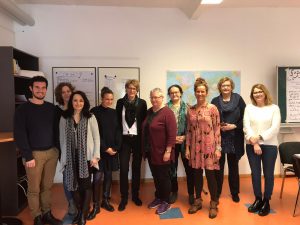
EKT project aims to improve the development of emerging technologies in order to reform the teaching profession
Education Sciences Faculty of University of Santiago de Compostela hosted the kick-off meeting of this initiative which achieved million euros for its implementation in the last call of the European Commission

Santiago, 21st of January 2020. Education Sciences Faculty of University of Santiago de Compostela hosted on Tuesday 21st and Wednesday 22nd of January the kick-off meeting of the project Educational Knowledge Transfer (EKT), a Consortium of Knowledge Alliances coordinated by USC trough the International Office of this institution. Partners from Spain, Austria, Ireland, Portugal, Belgium and United Kingdom are also involved in this initiative. EKT will work during three years on the development of collaborative educational methodologies and Smart technological frameworks. The project will work on a strategic triangle involving members of three areas: educational centers (schools and teachers), universities (Education Faculties and researchers) and technology-based companies and technological institutions (specifically those that offer ‘e-learning’ services).
In the opening event of the kick-off metting Carmen Fernández Morante, lead investigator of this project. Víctor Arce Vázquez, Vice-Rector for Students and Internationalization and Nieves Lagares, commissioner of the Citizenship Campus in University of Santiago de Compostela.
Possible implementation of the In-school placement
EKT will work on the development and experimentation of educational collaborative methodologies in a smart and scalable technology framework targeting official initial education studies of teachers in pre-school, primary and secondary education. The results of the project will contribute effectively to improve the learning of future teachers and to follow up their internship at schools, working on the possible implementation of an in-school placement.
Quote from a partner from the project (for instance International Office Director, lead investigator of the project, Vice- Rector for Internatilization) – Higlighting the relevance of EKT for each institution. In our press realease we included an statement from Carmen Fernández Morante.
EKT Consortium is composed by educational centres (universities and schools) and, on the Galician side, in addition to Tecnoeduc research group, Centro de Supercomputación de Galicia (CESGA) of the USC and the Galician multinational e-learning company Netex. CESGA, in charge of the technological part, will work on the development of a solution which responds to the needs of these institutions in order to create a training model, with diverse learning and collaboration environments. Several communication tools will be developed such as virtual campuses, e-portfolios or mobile applications which will provide students and teachers with a learning and learning collaborative environment, with an efficient and flexible management and follow-up.


 The ERASMUS+ project CONVOLUT (CONsider your skills for VOLUnTeering) follows on from the EU projects CORE, COOCOU, SCOUT, DISCOVER and KISS, which have been successfully implemented to date, with the aim of adapting the ProfilPASS as a competence assessment tool for people at the beginning of retirement. This target group is in transition from employment to retirement, requiring support during this important transition phase. CONVOLUT aims to inspire people at the beginning of retirement to engage in fulfilling and socially relevant volunteer work by giving them impulses and motivating them to self-reflect on their skills and knowledge for volunteer work. The project is coordinated by the DIE and is aimed at counsellors in the participating countries (Germany, Greece, Austria, Sweden, Slovenia, and Spain) who work with the target group and promote their potential for volunteering.
 December 2019 saw the project launch and Kick off meeting in the UK at the head office of Community Action Dacorum. This 2-year project brings together partners from the UK, Austria, Greece, Lithuania, Romania and Spain to share their knowledge and expertise to create innovative training products, which will combine the topics of language learning, cookery and inter-cultural dialogue.
 e-VIVA Newsletter 2
 and Spain we discussed the further procedure in the project. We are currently in the middle of the development phase of the planned learning platform and are very excited to see the final result!
 My Story Map pilot workshops were implemented in five partners countries (Italy, France, Spain, Austria and Belgium) and materials produced in previous phases of the project were tested. Read on in our latest Newsletter:
 Even now, caring for people from a different cultural background presents a challenge for many nursing staff. This is especially true when there are language barriers, but also when there is a lack of understanding for other cultures, and the resulting attitude towards medical treatment, care or support often leads to misunderstandings in the interaction between nursing staff and patients or their relatives.
 It is not only about patients with a migration background, but also about nursing staff from other cultural backgrounds. In order to strengthen competencies, training courses on intercultural communication and interaction for nursing staff are developed and implemented.