Categories
Allgemein

Three months in: how “AI Act(ing) in Adult Education” is already taking shape

Three months into our Erasmus+ project AI Act(ing) in Adult Education, we are already seeing how quickly ideas turn into real collaboration, and how relevant this topic has become for adult educators across Europe. As project coordinators, we kicked things off with a clear ambition: to help adult educators navigate artificial intelligence not just as a tool, but as a responsibility. Now, after the first phase of intensive work, that ambition is beginning to take concrete shape.

A strong start: Our Kick-Off-Meeting

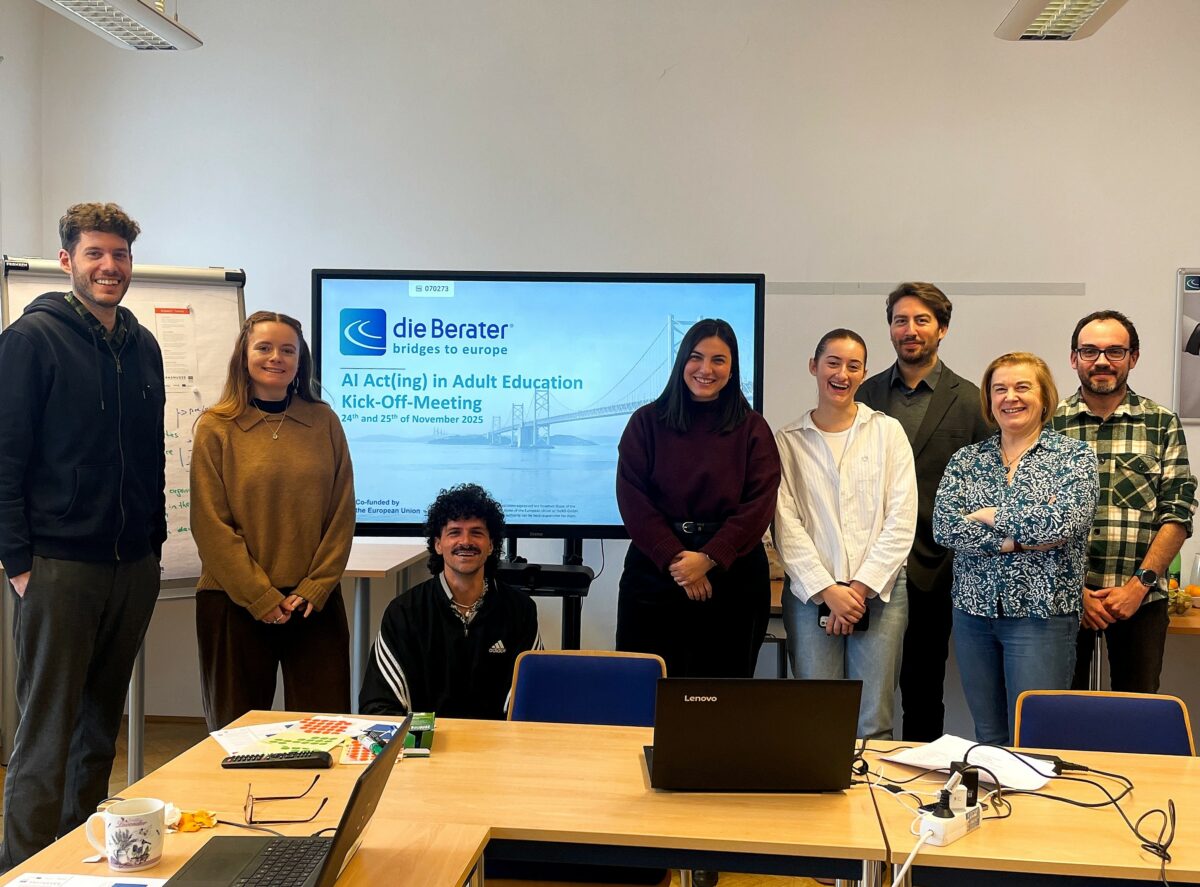
Back in November, we brought our consortium together for the official Kick-off Meeting in Vienna. It was more than a formal starting point, it was the moment where six organisations from across Europe aligned their perspectives, expectations, and expertise. From the very beginning, one thing stood out: while our partners come from different sectors, we share the same challenge. AI is already present in education, but structured support for educators is still catching up. The discussions during the meeting reflected exactly that. We did not spend time asking if AI matters. We focused on how we can make it usable, understandable, and responsible in real learning environments.

What we are working on right now: WP2 in action

At the moment, we are deep in the Research and Needs Analysis phase. And this is where things get particularly interesting. This phase is all about listening before creating. Together with our partners, we are:

  • mapping the current state of AI use in adult education across Europe
  • identifying gaps in AI knowledge and confidence among educators
  • engaging directly with stakeholders through surveys, interviews, and discussions

Our goal is simple but crucial: we want to build everything that follows on real needs, not assumptions. And already, some patterns are emerging.

Early insights: more curiosity than confidence

The first findings from our Austrian stakeholder engagement activities give us a much clearer picture of where the Austrian sector currently stands.

On the one hand, AI is already widely used. A strong majority of educators report regular or occasional use of AI tools, especially for tasks like lesson planning, content creation, and information search. Many also highlight clear benefits: saving time, adapting materials more easily, and enriching their teaching approaches.

At the same time, this widespread use does not automatically translate into confidence. What we see instead is a clear gap between awareness and applied competence. While many educators describe themselves as familiar with AI concepts, a significant share feel only moderately confident when it comes to using AI responsibly in their work.

Several recurring challenges are emerging:

  • Uncertainty around ethics and compliance, especially regarding data protection and the implications of the AI Act
  • Concerns about quality and reliability, with educators pointing out that AI-generated content is not always accurate
  • A lack of institutional guidance, with many organisations still developing or lacking clear AI policies
  • The feeling of being overwhelmed by the speed of AI development and the growing number of tools available

At the same time, we are also seeing strong motivation across the sector. Educators are not stepping back. They are actively experimenting, reflecting, and looking for ways to use AI meaningfully.

One particularly interesting insight from interviews is that AI use often remains at a basic level, supporting existing tasks rather than transforming learning processes. Moving beyond this “tool use” towards more strategic and pedagogical integration will be a key step forward.

Why this matters now

The timing of AI Act(ing) in Adult Education could not be more relevant. With the European AI Act now shaping how organisations approach AI, adult education providers are facing new expectations. Educators are not only users of technology, they are mediators between technology and learners.

That means they need more than technical skills. They need orientation, critical thinking, and practical guidance.

This is exactly where our project comes in.

Based on the findings from WP2, we will move on to developing:

  • a Guide to Responsible Use of AI in Adult Education
  • a structured AI training course for educators
  • open and accessible learning resources in multiple languages

Everything we build will be grounded in what educators actually need, and what they tell us right now.

What comes next

Over the coming months, we will continue gathering insights and consolidating results from across all partner countries. This will lead to a comprehensive transnational report that sets the foundation for the next steps.

At the same time, we will keep sharing updates, reflections, and behind-the-scenes moments from the project. Because for us, this is not just about delivering outputs. It is about shaping how AI is understood and used in adult education, together with the people who work in it every day.

Key takeaways

  • We are three months into AI Act(ing) in Adult Education and already deep in research and stakeholder engagement
  • Our Kick-off Meeting in November set a strong foundation for collaboration across six European partners
  • AI is already widely used in adult education, but confidence and guidance are still catching up
  • Work Package 2 ensures that all future outputs are based on real needs from the sector
  • Next steps include developing a practical guide and training course for responsible AI use

Curious to follow our journey or get involved? We regularly share updates, insights, and opportunities to engage.

Learn more: https://ai-acting.eu/
Follow us on LinkedIn: https://www.linkedin.com/company/ai-acting/
Follow us on Facebook: https://www.facebook.com/profile.php?id=61585392836704

Categories
Allgemein

MILES dritter Newsletter: Von den Pilots in die Praxis – und weiter ins Spiel

Wir freuen uns, MILES Newsletter #3 zu veröffentlichen – eine kompakte Momentaufnahme davon, wie das Projekt europaweit vom Planen und Testen immer stärker in die konkrete Umsetzung im Klassenzimmer übergeht.

Mit dem Start des dritten Projektjahres ist unser Fokus klar: Medienkompetenz und Pre-Bunking-Strategien müssen alltagstauglich, motivierend und leicht in den Unterricht integrierbar sein. In dieser Ausgabe zeigen wir, was wir bisher gelernt haben, was aktuell in Schulen passiert – und welche nächsten Schritte bereits vor der Tür stehen.

Das erwartet euch im dritten Newsletter:

Piloting-Erkenntnisse mit Praxiswert: Lehrkräfte und angehende Pädagog:innen haben die MILES-Plattform und Materialien in realen Lernsettings ausprobiert. Ihr Feedback hilft uns, die Nutzung zu vereinfachen, die Begleitung zu verbessern und sicherzustellen, dass unser Ansatz in unterschiedlichen Schulkontexten gut funktioniert.

Schüler:innen-Pilots 2026: In den Partnerländern werden die entwickelten Materialien nun direkt mit Schüler:innen erprobt. Ein kurzes Vorher-Nachher-Selbstassessment macht Veränderungen sichtbar – zum Beispiel bei der Sicherheit im Umgang mit Online-Informationen oder beim Erkennen irreführender Inhalte.

Highlights aus dem Partnermeeting in Wien: Anfang Februar 2026 traf sich das gesamte Konsortium in Wien, um Pilot-Ergebnisse auszuwerten und die nächsten Schritte zu koordinieren. Unser Ziel: Materialien und Plattform sollen nicht nur pädagogisch fundiert, sondern für Lehrkräfte auch wirklich praktisch nutzbar sein.

Der nächste große Schritt: Brettspiele! Besonders viel Energie steckt derzeit in der Brettspiel-Phase: Schüler:innen übersetzen ihre Lerninhalte in spielerische Formate, die Pre-Bunking-Strategien greifbar und teilbar machen – und Diskussionen über Desinformation auch außerhalb der Schule anregen.

Wir laden Lehrkräfte, Organisationen und Entscheidungsträger:innen ein, in Newsletter #3 reinzulesen und zu entdecken, wie MILES eine inklusive, kritische und selbstbewusste Informationskompetenz fördern kann – online wie offline.

MILES dritter Newsletter hier lesen.

Categories
Allgemein

Gelebte Nachhaltigkeit beim Lehrausgang ins Waldviertel im Rahmen des EU-Projekts EXTOR

Im Zuge des Unterrichtsfachs Betriebspraktikum Nachhaltigkeit hatten wir Schülerinnen und Schüler der HLF Krems die Möglichkeit am EU-Projekt EXTOR teilzunehmen. 

Das EU-Projekt EXTOR (Experiential Tourism for Regional Development) fördert nachhaltige und erlebnisorientierte Tourismusformen und bietet jungen Menschen die Möglichkeit, Tourismusentwicklung direkt vor Ort zu erleben und gute Beispiele zu präsentieren.

Nach den wichtigsten Inputs zu den Themenbereichen nachhaltiger Tourismus, Slow Tourismus, Ökotourismus und ländlicher Tourismus konnten wir unter diesen Gesichtspunkten unsere Exkursionsziele für die geplante Exkursion ins Waldviertel näher recherchieren. Betreut wurden wir hierbei durch Lisa-Marie Mahlknecht vom Consultingunternehmen „die Berater“ und durch unsere Lehrkraft Maria Kremsner, die uns durch den Prozess begleiteten.

Am 30. September startete dann unser durchaus spannender Lehrausgang ins Waldviertel.

Der Tag begann im Mohndorf Armschlag, wo alles im Zeichen des Mohns steht. Hier wurden wir bei der Familie Neuwiesinger sehr herzlich aufgenommen. Wir erfuhren hier, wie alles ausgehend von einer Idee entstand und wie sich das Dorf durch eine gelungene Kombination von Landwirtschaft, Tradition und Kreativität zu einem beliebten Ausflugsziel entwickelte. Die enge Verbindung von Regionalität, Zusammenhalt der Bevölkerung und die touristische und gastronomische Umsetzung beeindruckten uns besonders.

Weiter ging es zur Schwarz Alm Zwettl, einem Hotel, das Nachhaltigkeit und Regionalität in den Mittelpunkt stellt. Wir erhielten interessante Einblicke in den Hotelbetrieb, das Umweltkonzept und die Bedeutung nachhaltiger Angebote im Tourismus.

In Zwettl besuchten wir die Tourismusinformation und durften mit Frau Gutmann die SONNENTOR Stadtlofts erkunden. Hier wird Geschichte perfekt erlebbar gemacht. Mitten in der Stadt Zwettl findet man 5 einzigartige Ferienwohnungen, die Ruhe, Erholung und zugleich Erlebnis bieten. Sie zeigen, wie die Erhaltung denkmalgeschützter Bauwerke, innovatives Design, Komfort und Regionalität erfolgreich kombiniert werden können und zum Verweilen einladen.

Anschließend ging es weiter zum Herz-Kreislauf-Zentrum Groß Gerungs, wo wir erfuhren, wie Gesundheitstourismus und Prävention zu wichtigen Säulen der regionalen Entwicklung geworden sind. Hier ist vor allem auch die „Xundheitswelt“ als wichtiger Motor für die regionale Landwirtschaft zu erwähnen.

Ein besonderes Highlight war der Besuch des Sonnenleitn Alpakahofs in Großpertholz. Zwischen sanften Hügeln gelegen, konnten wir die zutraulichen Alpakas aus nächster Nähe erleben. Herr Vogler gab uns spannende Einblicke in die Haltung, Pflege und Vermarktung der Tiere – ein gelungenes Beispiel dafür, wie Landwirtschaft und Tourismus auf charmante Weise verbunden werden können.

Zum Abschluss erhielten wir noch Inputs zum Tourismus in Schrems. Hier wurde uns die Arbeit des regionalen Destinationsmanagements vorgestellt. Wir besichtigten die ruhig gelegenen Baumhäuser mitten im Wald und die Himmelsleiter mit dem Blick ins Hochmoor.

Ein großes Dankeschön an alle, die uns recht herzlich aufgenommen und sehr offen mit uns diskutiert haben.

Das Waldviertel ist sehr vielfältig und hat wirklich was zu bieten! Besonders interessant war für uns auch die Erkenntnis, wie eng Betriebe, Gemeinden und Organisationen zusammenarbeiten, um das Waldviertel nachhaltig zu positionieren. 

Der Lehrausgang zeigte eindrucksvoll, wie vielfältig Nachhaltigkeit im Tourismus gelebt werden kann – von der Landwirtschaft über Hotellerie bis hin zu Gesundheit und Regionalentwicklung. 

Diese Eindrücke haben wir in Business Präsentationen, Pitches und Videos umgewandelt und auch präsentiert.

Durch das EU-Projekt EXTOR konnten wir erleben, wie die Innovation, die Zusammenarbeit und das Bewusstsein für Nachhaltigkeit den Tourismus der Zukunft prägen.

Die Nachhaltigkeitsgruppe der 4AHLT & 4BHLT

Categories
Allgemein

INNOVATE: Strengthening Innovation Management Across Europe

INNOVATE is an Erasmus+ project supporting European Vocational Enterprises (EVEs) in strengthening their innovation‑driven management skills. It builds on three practical principles: setting ambitious goals that spark innovation (“promise beyond ability”), creating clarity through simple boundaries (“always and never”), and drawing strategic inspiration—the spark behind truly impactful ideas.

Some ideas gain momentum while others never move beyond the whiteboard. The difference often lies in having a clear process to shape, test, and implement them. INNOVATE’s Innovation Management System provides exactly that: a structured way to turn intention into action and action into measurable results.

Over the past year, partners from six European countries have worked together to make innovation management more accessible for entrepreneurs and EVEs. All multilingual project results are available at www.innovate-project.eu

Key Project Results
Innovation Management Training (self‑paced, free, open access)
A practical online programme aligned with ISO 56000, covering leadership and innovation culture, idea generation, partnerships, AI integration, and IP protection—designed for flexible, self‑directed learning.

Innovation Management Whitepaper (international research)
A cross‑country analysis of how EVEs approach innovation, including insights, best practices, recommendations, and a self‑assessment perspective to support long‑term impact.

Self‑Assessment Tool(digital and printable)
A structured questionnaire helping EVEs evaluate their current innovation practices, identify strengths, and pinpoint clear areas for improvement.

Innovation Management Manual (digital and printable)
A step‑by‑step guide to implementing innovation management in practice—covering resources, processes, culture, and the transition toward ISO 56000‑aligned ways of working.

Trainers’ Guide (digital and printable)
A companion resource for facilitators, summarising the training structure and methods to support interactive, practice‑oriented delivery.

Innovation is more than generating ideas—it’s about creating the processes, culture, and mindset that allow those ideas to thrive. Whether you are a student, entrepreneur, SME leader, innovation officer, or policymaker, INNOVATE offers practical tools and inspiration you can apply directly in your work.

Categories
Allgemein

Workshop digital villages: from vision to practice!

The Our Digital Village project is proud to launch the workshop series “Digital Villages: From Vision to Practice”, dedicated to exploring how rural and urban communities can bridge the digital gap. This initiative brings together local actors, civil society organisations, educators, policymakers, and partners from across Europe to exchange ideas, share practical experiences, and co-create strategies for the digital transformation of rural areas.

Two online workshops will take place in autumn 2025, offering inspiration, real-world examples, and practical tools. The first session, How to Start a Digital Village Approach Locally, will be held on 23 September 2025 from 10:00 to 13:00 CEST. It will focus on the initial steps required to design and apply the digital village approach in local contexts.

Register here

The second workshop, Building Digital Skills for Rural Communities, will follow on 21 October 2025 from 10:00 to 13:00 CEST. This session will highlight strategies to strengthen digital skills and promote inclusion and capacity-building in rural communities.

Register here

Participants can look forward to case studies and stories from Ukraine, Italy, Portugal, and beyond, alongside practical methodologies from the Our Digital Village project and interactive exercises that can be directly applied in their own communities. The workshops are designed to inspire, provide hands-on knowledge, and encourage collaboration across borders.

Categories
Allgemein

Strengthening agency in vocational education — the DIDACTIVE Competence Framework is now available!

As part of the Erasmus+ funded DIDACTIVE project, a comprehensive Competence Framework has been developed to define and operationalize the concept of “agency competence” in adult learning. This framework responds to the growing need for inclusive, learner-centered approaches that empower individuals — especially those with low qualifications — to take control of their educational and professional journeys.

What is “agency competence”? Agency competence refers to the ability of individuals to make autonomous, informed decisions and to act intentionally in pursuit of personal and career goals. It is a key skill for navigating today’s dynamic labor market and for fostering lifelong learning:

What does the framework offer?

  • A shared definition of agency competence across partner countries
  • Key dimensions and indicators for training, assessment, and support
  • Practical tools for educators, trainers, and career advisors
  • A foundation for inclusive vocational education policy and practice

Developed collaboratively by partners from Italy, France, the Netherlands, Greece, Austria, and Croatia, the framework reflects diverse educational contexts and is designed to be adaptable across Europe.
The Competence Framework is available in all partner languages and can be downloaded from the project website: didactiveproject.eu

Categories
Allgemein

Be Inclusive! Newsletter #4 – Final Highlights & Resources

As the Be Inclusive! project reaches its successful conclusion, we’re proud to share the final newsletter packed with insights, tools, and stories that promote inclusive employment for people with disabilities in small and medium-sized enterprises (SMEs).

This edition features the newly released brochure “People with Disabilities in the Labour Market: Placement, Inclusion and Sustainable Employment in SMEs”, offering practical strategies for employers and stakeholders. You’ll also find eight micro-learning videos now available on YouTube and Vimeo—perfect for educators, HR professionals, and career coaches seeking actionable guidance on inclusive workplace practices.

To further support real-world implementation, the project has developed additional learning materials designed to break down barriers and foster equal opportunities across Europe.

Whether you’re an employer, educator, policymaker, or advocate, this newsletter is your gateway to the project’s most valuable outcomes.

All updates, resources, and links are available in the full newsletter.

Visit www.be-inclusive.net to explore more.

Categories
Allgemein

TUTOR Newsletter Mobility Week in Vienna

New in our newsletter: Insights from the TUTOR Mobility Week in Vienna – How can teachers foster real inclusion in the classroom? This edition takes you inside a transformative week where educators from Austria, Ireland, Turkey and Greece explored diversity, equity and belonging through immersive learning experiences.

What to expect in this issue:

  • Visits to inclusive spaces such as the Q:WIR Youth Centre and Löwenherz bookshop
  • A city walk through Vienna’s hidden corners guided by lived experiences of homelessness
  • Workshops on anti-racism, gender diversity and migrant identity
  • Cultural visits to the House of Austrian History and the Vienna Museum
  • Reflections on power, privilege and practical strategies for inclusive teaching

Read the full newsletter to discover how inclusive education becomes a lived experience.

Categories
Allgemein

Discover the Be Inclusive! Video Series

The Be Inclusive! project has launched a powerful collection of eight short videos designed to promote inclusive employment for people with disabilities—especially within small and medium-sized enterprises (SMEs).

Each video offers practical insights, real-life examples, and expert guidance on how employers, educators, and career advisors can foster inclusive workplaces. From recruitment strategies to workplace adjustments, the series covers key topics that help break down barriers and build environments where everyone can thrive.

These videos are ideal for use in training sessions, workshops, or simply as inspiration for anyone looking to make a difference. Whether you’re an HR professional, a policymaker, or a business owner, you’ll find actionable ideas and moving stories that challenge assumptions and encourage change.

All eight videos are available now on the Be Inclusive! YouTube channel.

Categories
Allgemein

Shaping education effectively and optimistically – launch of the EU project OPE

We’re excited to launch OPE – Optimistic Pathways in Education, a new EU project that brings together partners from Greece, Austria, Cyprus, Turkey, and Italy. Our shared goal: to strengthen educational optimism and self-efficacy across schools through a whole-school development approach.

At the heart of OPE are two key concepts:

🔹 Academic optimism – a shared belief in the value of learning, grounded in trust, collaboration, and a strong commitment to student success.

🔹 Teacher self-efficacy – the conviction that one can positively influence learning, which boosts teaching quality, motivation, and professional resilience.

To guide this work, we use the PROSPER framework – a school-based model grounded in positive psychology, defined by seven dimensions:

Positivity – cultivating a positive mindset
Relationships – building strong, supportive connections
Outcomes – maintaining a focus on learning goals
Strengths – recognising and using individual strengths
Purpose – fostering a sense of meaning
Engagement – encouraging active participation
Resilience – developing capacity to cope and grow

PROSPER builds on the well-known PERMA model and expands it with a practical focus on resilience and strengths – key to wellbeing and learning in school settings.

We look forward to exchanging ideas and sharing insights as OPE unfolds!

#PositiveEducation #WholeSchoolApproach #EUProjects